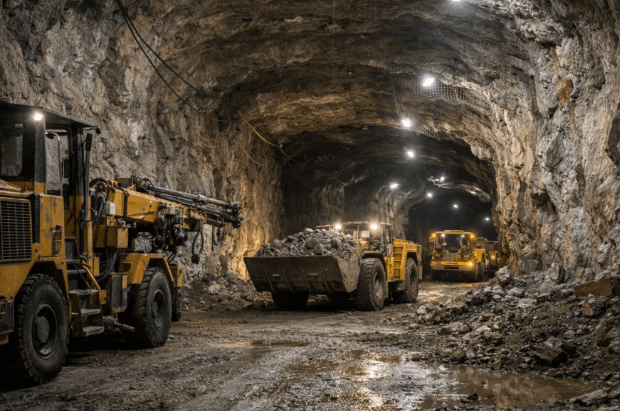
Short-term underground work comes with a particular kind of pressure. You may have 12–24 months to deliver development, ramp up production, and prove the plan. That timeline changes how equipment decisions should be made. In longer projects, a weak choice can be corrected over time. In short-term planning, mistakes show up early and linger, because there is little room to reset the rhythm once the cycle becomes stop-start.
Picking machines here is less about going after one top number and more about guarding steady work. A tool can seem great on specs but still drag your progress if it adds extra setup, causes more fixes, or leads to waits later on. The best picks are those that keep the work cycle going with fewer stops.
What Short-Term Planning Really Changes Underground
Short-term planning shifts your focus from lifetime value to time-to-impact. Lead times, training time, and the schedule cost of a single bad week become outsized. Underground operations amplify this effect through limited access, tight traffic control, ventilation windows, and work that depends on clean handovers between teams.
Real-world variability also carries more weight in short projects. Ground conditions change. Heading profiles evolve. Crews rotate. If underground mining equipment needs ideal conditions to deliver stable performance, the plan becomes fragile. A practical lens helps here: the shorter the planning window, the more you should favor equipment that reaches routine performance quickly and holds it across normal variations.
Start With the Full Development Cycle, Not One Machine
Short-term selection often goes off track when it begins with a single machine spec. Drilling speed, payload, or power may look decisive. Underground development rarely behaves that way. Advance rate is a chain made of positioning, drilling, tool handling, checks, charging, blasting, face clearance, and preparation for the next round. When one stage waits, the entire round stretches.
A cycle-first view makes bottlenecks obvious. You may see strong drilling metrics, yet face clearance does not keep pace. The next drilling shift arrives and the heading is not ready. Over a few weeks, that pattern becomes normal, and it quietly reshapes the schedule. If you want a simple planning check, list the most common reasons drilling waits. When the top items are “not drilling issues,” the risk is usually system mismatch rather than insufficient machine capability.
See also: Starting a Tech Company With Zero Coding Knowledge in 2025
Flexibility Often Beats Peak Specs in Short Projects
Short-term underground projects reward equipment that adapts quickly and stays stable when conditions are not perfect. Flexibility shows up in practical ways: how fast the unit sets up on uneven floors, how stable it remains at less-than-ideal drilling angles, how easily it works across changes in heading geometry, and how well it holds repeatable performance across different operators.
Peak specs still matter, but they tend to matter most in ideal conditions. Short projects rarely enjoy ideal conditions for long. A machine that delivers slightly lower peak output but maintains steady progress across changing faces often produces better results in total meters and fewer “lost shifts” spent correcting problems.
Operator variability is part of the same equation. In short-term work, staffing changes are common. If equipment performance relies on a small number of expert operators, the plan inherits that risk. Equipment that is easier to standardize, easier to teach, and more forgiving of minor technique differences usually protects the schedule better.
Downstream Flow Determines Your Real Output
Many short-term plans struggle not because drilling is slow, but because downstream operations cannot keep pace. After blasting, the site still needs predictable fragmentation, manageable muck piles, and clearance capacity that matches the pace of development. When fragmentation is inconsistent or the muck pile is difficult, loading slows, haulage cycles stretch, and face turnover becomes unreliable. The next round starts late, and the project pays for capacity it cannot fully use.
This is why equipment selection should consider downstream flow as a first-class constraint, not a secondary detail. If your plan targets higher development rates, it must also support that rate with clearance and haulage capacity that remains stable under real conditions, not just under ideal blasts. In short projects, the penalty for downstream mismatch is immediate, because the schedule does not have time to absorb repeated delays.

Reduce Dependency on Perfect Crews and Perfect Days
Short-term underground projects rarely run with perfectly consistent crews. Skill levels vary. Rotation happens. New operators join. If equipment requires specialist-level operation to avoid errors, the plan becomes sensitive to staffing, and that sensitivity tends to show up as rework, slow resets, and uneven cycle times.
Selection should favor repeatable routines: daily checks that are practical, maintenance that fits the site rhythm, parts support that does not create long gaps, and operating behavior that remains stable when conditions change. Reliability here is not only uptime. It is consistency—fewer surprises, fewer small stops, and fewer corrective actions that break the cycle.
Use Time-to-Impact as Your Main Selection Filter
In short-term planning, early gains carry more value than late refinements. Equipment that delivers stable performance in the first months protects the schedule and prevents the project from entering a “recovery mode” where every week is spent trying to catch up. Equipment that needs long tuning, complex integration, or extensive retraining may still be strong technology, but it can be a poor fit if the benefits arrive too late.
A time-to-impact filter is straightforward. For each key unit, assess how quickly it can be commissioned into routine work, how steep the learning curve is for an average crew, how disruptive common failure modes are underground, and how easily the site can support maintenance without derailing production. In short projects, complexity often adds risk faster than it adds value.
Closing Thought: Selection Is a Planning Tool, Not Just a Purchase
Short-term underground planning is unforgiving. Equipment selection should protect the cycle, not just promise performance. When your choices fit the full development chain, adapt to changing headings, and tolerate normal variability in crews and conditions, advance rates tend to follow. When those conditions are not met, the project loses time through waiting, rework, and downstream disruption—and those losses are hard to recover within a short planning window.
For metal-ore underground operations, it can also help to work with suppliers that frame equipment as part of a coordinated development system rather than isolated units. ZONGDA (QINGDAO ZONGDA MACHINERY CO., LTD) is one example that positions its offering around underground metal-ore applications and a broader range of underground equipment that can support development rhythms when coordination matters as much as individual machine output.
FAQ
Q1: Should short-term projects avoid high-spec machines?
A: Not necessarily. High-spec equipment can be a strong fit when the site can support it and the crew can run it consistently. The risk is selecting a high-capability unit while the rest of the cycle cannot match its pace, turning “capacity” into waiting and schedule slip.
Q2: What is the most common equipment selection mistake in short-term underground planning?
A: Choosing machines in isolation. A strong drill or haulage unit can still lose the schedule if handovers are slow, clearance lags, or routine maintenance becomes disruptive. The cycle, not the individual machine, is the best measure of fit.