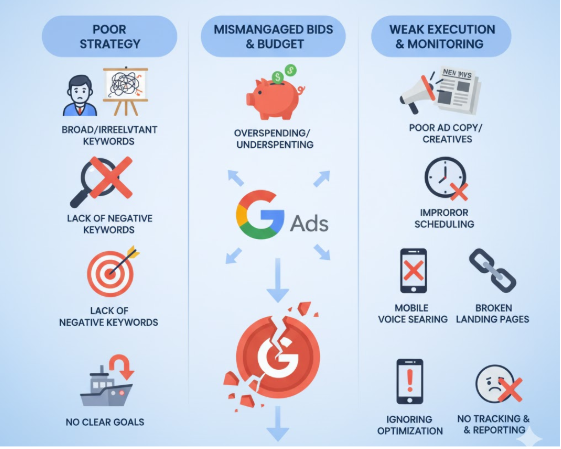
A friend who runs an online clothing store called me frustrated last week. He’d burned through ₹1.2 lakhs in three months on advertising with almost nothing to show for it. When I asked to see his campaigns, the problems jumped out within minutes—wrong bidding strategy, no negative keywords, landing pages that took forever to load on mobile, and ad copy that hadn’t been tested even once.
His situation isn’t unique. Most businesses make the same expensive mistakes that drain budgets without delivering results. The worst part? These errors are completely preventable if you know what to look for.
The Bidding Strategy Disaster
One of the costliest mistakes I see repeatedly is using the wrong bidding strategy for campaign goals. There are three main types—click-based, conversion-based, and value-based—and choosing incorrectly throws money out the window.
Click-based strategies like Manual CPC or Maximize Clicks treat all clicks equally. Someone who bounces off your site in two seconds costs the same as someone who spends ten minutes browsing products. That’s problematic because most clicks don’t convert, meaning you’re paying equal amounts for valuable and worthless traffic.
Conversion-based strategies like Maximize Conversions and Target CPA optimize toward actual conversions instead of just clicks. The algorithm learns which searches, locations, times, and devices generate conversions, then adjusts bids accordingly. This targets people likely to take action rather than just anyone who might click.
Value-based strategies take it further by optimizing for conversion value, not just conversion quantity. For ecommerce sites, this means focusing on higher-revenue purchases instead of treating a ₹500 sale the same as a ₹5,000 sale. For lead generation businesses, you can assign higher values to qualified leads versus general inquiries.
The mistake happens when businesses use Manual CPC for months because it feels safer having control, but they’re actually losing money compared to smarter automated strategies. Or they jump into Target CPA with aggressive targets before the algorithm has enough data to learn, which starves campaigns of traffic. Smart Bidding needs 30-50 conversions and 2-6 weeks of learning time to calibrate properly.
Another common error is using Target CPA with constrained budgets that don’t give the algorithm flexibility to optimize. If your budget is too limited or you can’t spend what’s needed to hit your target, Maximize Conversions works better.
See also: The Music City Lockout: How Nashville Locksmiths Rescue Musicians on Tour Nights
The Ad Copy Nobody Tests
Most businesses write one set of ads and call it done. They never test headlines, descriptions, calls-to-action, or different value propositions. This is like launching a product without ever asking if customers actually want it—you’re guessing instead of knowing what works.
Ad copy testing reveals what resonates with your audience versus what falls flat. The headline that you think sounds professional might perform worse than something conversational and direct. A subtle change in wording can boost click-through rates by 30-40%, but you’ll never know unless you test systematically.
The proper approach involves testing one variable at a time—change the headline but keep everything else constant, then test again with a different description. Run tests until each variation gets at least 100 clicks so you have statistically meaningful data. The winning ad becomes your new baseline, then you test against that one, creating a continuous improvement cycle.
Most businesses skip this because testing feels time-consuming, but the reality is that untested ads waste far more money than the effort testing requires. You’re essentially running campaigns blindfolded, hoping your first guess was correct rather than using data to guide decisions.
Google Ads makes split testing easy—you can run multiple ad variations simultaneously in each ad group and the platform shows which ones perform better. Ignoring this built-in capability means leaving money on the table every single day your campaigns run.
The Mobile Optimization Failure
Here’s a stat that should wake everyone up: mobile video ad spending is expected to surpass mobile search spending for the first time in 2026, with video accounting for nearly 40% of all mobile ad spend. The mobile advertising market exceeds $228 billion globally, and businesses not optimized for mobile are missing massive opportunities.
Yet I constantly see campaigns where ads look great on desktop but terrible on mobile devices. Headlines get cut off, descriptions don’t fit properly, landing pages load slowly or display incorrectly, and forms are impossible to fill out on small screens. Every one of these problems drives potential customers away after you’ve already paid for the click.
Mobile users behave differently than desktop users. They’re often on-the-go, have less patience, and need information faster. Your ads need mobile-specific copy that’s concise and actionable. Landing pages must load in under three seconds or people bounce. Forms should be simplified for mobile—asking for ten pieces of information when two would suffice kills conversion rates.
Mobile bid adjustments let you increase bids specifically for mobile traffic when that’s where your customers are. If analysis shows mobile users convert better than desktop, you should bid more aggressively for mobile impressions. Yet most businesses ignore these settings and let the platform treat all devices the same.
Location-based mobile advertising represents another missed opportunity. Nearly 30% of people search for local businesses daily on mobile devices, usually when they’re already nearby and ready to buy. Businesses not targeting “near me” searches or using location extensions are invisible during these high-intent moments.
The shift toward short-form video content is transforming mobile advertising too. Platforms show that 85% of videos on social media are watched without sound, meaning captions and visual storytelling matter more than ever. Brands creating mobile-optimized video content see completion rates above 90% in some formats.
Why Professional Management Prevents These Errors
This is where a google ads agency becomes invaluable. Professional managers have seen these mistakes hundreds of times across different accounts, so they know exactly what to avoid from day one. They set up proper bidding strategies matched to business goals, ensuring campaigns optimize toward what actually matters—conversions and revenue, not just clicks.
Agencies implement systematic testing protocols that continuously improve performance. They don’t guess which ad copy works—they test variations, analyze results, implement winners, and repeat the process. This data-driven approach consistently outperforms the “write it and forget it” method most businesses use.
Mobile optimization gets handled properly too. Professionals ensure ads display correctly across all devices, landing pages load fast on mobile networks, and bid adjustments favor the platforms where your customers actually convert. They stay current with trends like the shift toward mobile video and adjust strategies accordingly.
The platform itself keeps evolving with new features, updated best practices, and algorithm changes that affect performance. Staying current requires dedicated attention that business owners simply don’t have time for while running their companies. Agencies make this their full-time focus, so clients benefit from expertise that’s constantly updated.
Mistake prevention alone justifies the investment. When campaigns are structured correctly from the beginning, budgets go toward effective advertising instead of expensive learning experiences. No wasted months figuring out why clicks don’t convert. No budget burned testing approaches that professionals already know don’t work. No opportunities missed because technical details were configured incorrectly.
The Google Shopping Opportunity Most Businesses Miss
For ecommerce businesses specifically, Google Shopping campaigns represent enormous potential that often goes untapped. Shopping ads appear at the very top of search results with product images, prices, and business names—placement that drives significantly higher click-through rates than text ads.
The setup requires technical knowledge though. You need a Google Merchant Center account with properly formatted product feeds that refresh regularly. Product titles, descriptions, and categorization must follow specific guidelines or your products won’t show up. Image quality matters tremendously because that’s what catches attention in search results.
Campaign structure affects performance dramatically too. Professionals organize Shopping campaigns by product categories, margins, best-sellers, or seasonal items to control bidding and budget allocation precisely. Generic campaign structures that dump all products together waste money because high-margin and low-margin items compete for the same budget.
Feed optimization is another technical area where mistakes prove costly. Missing or incorrect product attributes reduce visibility. Titles that don’t include relevant search terms mean your products won’t show up for queries they should. Poor quality images get fewer clicks even when products do appear.
Most business owners don’t have time to manage these technical details properly, which is why Shopping campaigns often underperform when managed in-house. Agencies handle the technical setup, feed optimization, campaign structure, and ongoing management that make Shopping campaigns profitable.
Making the Smart Choice
Every day businesses waste money on campaigns configured incorrectly, using wrong bidding strategies, running untested ads, and ignoring mobile optimization. These aren’t small inefficiencies—they’re the difference between campaigns that deliver 3x returns and campaigns that lose money.
Working with a best google ads agency prevents these expensive mistakes through expertise built managing hundreds of campaigns across different industries. You get proper setup from day one, systematic testing that improves performance continuously, and ongoing optimization that adapts to platform changes and market shifts.
The alternative is continuing to make the same costly errors that drain budgets while competitors who figured this out steal your customers. Smart businesses realize that advertising expertise isn’t their core competency—running their business is—so they partner with professionals who live and breathe paid advertising.
Campaign success comes down to thousands of small decisions made correctly—bidding strategies aligned with goals, ad copy tested methodically, mobile experiences optimized properly, technical details configured right. Getting all these pieces working together requires knowledge that takes years to develop, or you can access that expertise immediately by working with people who already have it.